
Introduction: The Battle for Mental Clarity in 2026
Introduction: The Battle for Mental Clarity in 2026
The mental load is invisible, relentless, and distinctively heavy for UK mums. It is not merely knowing that today, January 9, is a Friday; it is remembering that "Friday" implies a washed PE kit, a rescheduled NHS appointment, and the deadline for the school trip deposit. This cognitive burden defines the battle for clarity in 2026. We aren't just choosing a stationery product. We are selecting an external brain.
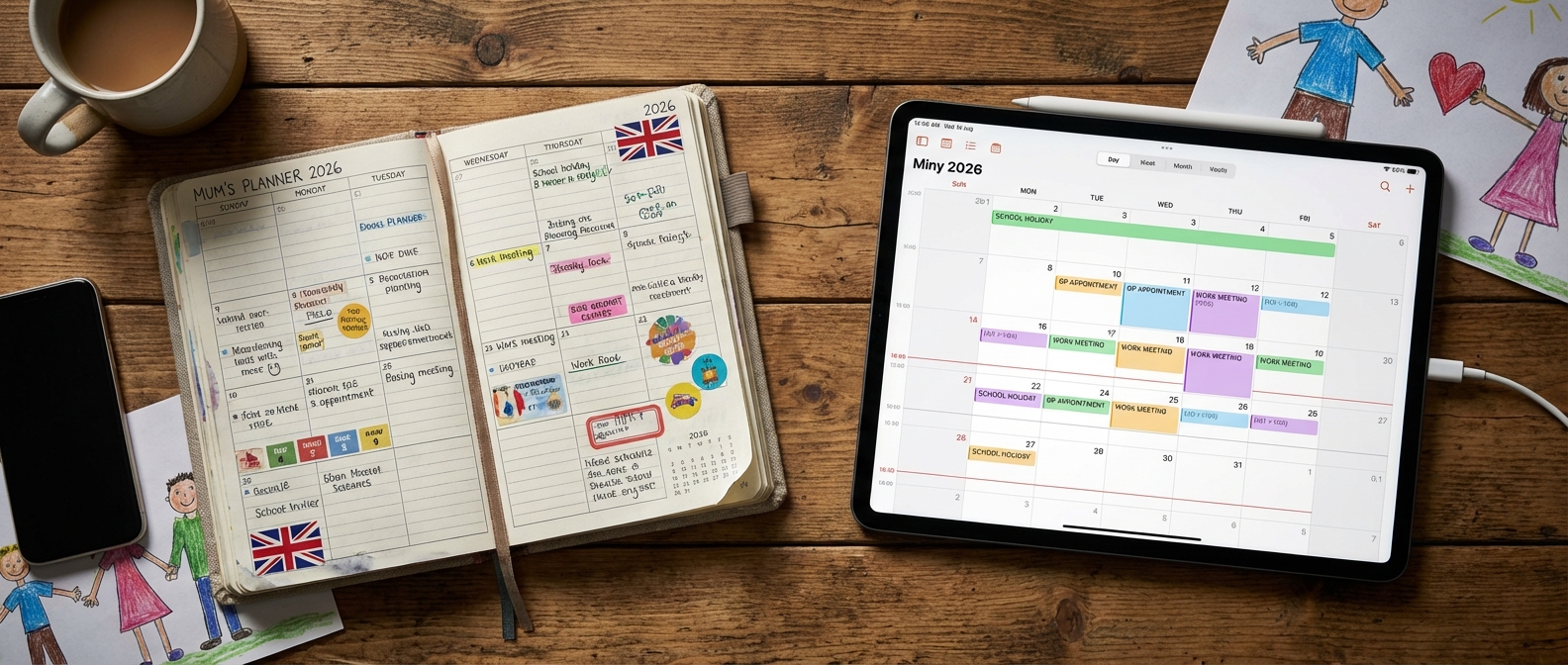
The debate regarding the mom planner vs digital calendar UK landscape has evolved. It is no longer a question of being "old school" versus "tech-savvy." It is a strategic choice between the tactile retention of paper and the automated efficiency of apps like Google, Cozi, or Apple Calendar.
Effective family organization requires a system that withstands the chaos of UK school term dates, bank holidays, and shifting work schedules. Before we dissect the features, understand the core operational differences:
| Feature | Physical Mom Planner | Digital Calendar (Apps) |
|---|---|---|
| Primary Benefit | Memory retention & focus | Automation & reminders |
| Accessibility | Always visible on the counter | Always in your pocket |
| Shared Access | Visual for the whole family | Instant sync for partners |
| Battery Life | Infinite | Dependent on device |
To reclaim your headspace this year, you must decide how your brain processes information best. Are you looking for a dedicated space to physically map out your week? If so, exploring the 12 Best Personalized Mom Organizers in the UK (2026 Reviewed) might be your first step. Alternatively, if you need pinging notifications to survive, the digital route awaits.
Here is why the mental load requires more than just a datebook:
- Context Switching: Moving from "employee" to "parent" requires a system that bridges the gap.
- The Micro-Details: Non-uniform days and bake sales don't always fit neatly into a standard Google Calendar slot.
- Accountability: A physical book on the kitchen island forces family engagement in a way a hidden app notification cannot.
The Case for the Paper Mom Planner
The paper mom planner remains a staple in 2026 because it offers superior memory retention through the cognitive act of writing. Beyond organization, it provides a crucial digital detox, transforming daily scheduling into a mindful ritual. Whether using a day-per-page or week-to-view format, a physical planner serves as a tangible keepsake of family life.
The Cognitive Edge: Why Writing Wins
Neuroscience supports the analog approach. When you physically write down a school play date or a vaccination appointment, your brain engages in "deep encoding." This process significantly improves memory retention compared to tapping a glass screen. You aren't just entering data; you are committing the event to your mind. This tactile engagement prevents the "swipe and forget" phenomenon so common with relentless push notifications.
The Ritual of Planning as "Me Time"
In a world dominated by blue light, opening a physical planner creates a necessary boundary. It forces a digital detox, allowing you to step away from the noise of social media and work emails to focus entirely on family logistics.
This disconnect turns administrative tasks into a moment of calm. Customizing your layout with stickers, washi tape, or color-coded pens transforms the mundane into a creative outlet. For those seeking tools that support this creative freedom, the 12 Best Personalized Mom Organizers in the UK (2026 Reviewed) – Taming the Chaos provide the perfect canvas for blending utility with mindfulness.
Popular UK Formats Explained
Choosing the right layout is critical for success. UK mums typically gravitate toward A5 sizes for portability, but the internal structure depends on your specific mental load.
| Layout Type | Best For | Key Benefit |
|---|---|---|
| Day-Per-Page | High-detail planners and journalers. | Offers ample space for hourly schedules, meal tracking, and daily gratitude journaling. |
| Week-to-View | Visual thinkers and busy professionals. | Allows you to see the entire week's "mental load" at once, preventing overbooking. |
| Month-at-a-Glance | Long-term strategists. | ideal for tracking school terms, holidays, and billing cycles found in our Family Budget Planning Guide. |
| Vertical Columns | Multi-child families. | Dedicate one column per family member to manage conflicting schedules easily. |
The Archival Value
A digital calendar is ephemeral; a paper planner is permanent. Years from now, a cloud server won't hold the same emotional weight as a dusty book found in the attic. One of the most underrated paper diary benefits is the creation of a keepsake. You are archiving your life in real-time—capturing the handwriting that changes when you are tired, the doodles in the margins, and the chaotic beauty of raising children in 2026.
If you are ready to commit to the analog method, knowing where to source high-quality stationery is the next step. You can find specific retailer recommendations in our guide on Where to Buy Mom Planners Online in the UK: The Ultimate 2026 Guide.
Pros: Visualizing the Chaos
Pros: Visualizing the Chaos
When evaluating the mom planner vs digital calendar UK debate, the physical planner wins on cognitive clarity and reliability. A paper planner transforms abstract time into a tangible map, allowing you to physically grasp your schedule without fighting notifications, software updates, or low battery warnings.
For many UK mums in 2026, the screen fatigue is real. Switching to a physical book offers a distinct psychological advantage. Here is why the analog approach remains a powerful contender:
- Zero-Tech Reliability (No Battery Required): Your paper planner never dies. It does not require a charging cable, a Wi-Fi connection, or a software update in the middle of school drop-off. It is instantly accessible 100% of the time. Whether you are at a GP appointment with no signal or managing a power cut, your schedule remains visible.
- The "Week-at-a-Glance" Advantage: Digital calendars often require clicking, scrolling, or switching views to see the full picture. A physical planner lies flat, offering a panoramic view of your entire week. This spatial layout helps your brain visualize gaps in the schedule, preventing the dreaded double-booking scenario before it happens.
- Tactile Dopamine: There is a scientifically backed satisfaction in physically crossing a task off a list. That scratch of ink over a completed chore provides a sense of finality and accomplishment that clicking a digital checkbox simply cannot replicate.
- A Diary for the Future: Unlike digital data which often disappears into the cloud or gets deleted to save space, a filled planner becomes a history book. It acts as a memory log, preserving the small details of family life—from milestones to funny quotes—creating a legacy you can hold. Many mothers opt for 12 Best Personalized Mom Organizers in the UK (2026 Reviewed) specifically to create these keepsakes.
Paper vs. Digital: The Sensory Experience
To understand the core difference in usability, compare the sensory experience of managing your week:
| Feature | Paper Mom Planner | Digital Calendar |
|---|---|---|
| Visual Scope | Simultaneous View: See appointments, notes, and tasks for the whole week instantly. | Tunnel Vision: Often limited to daily views or cluttered monthly dots requiring clicks. |
| Input Speed | Fast: Open and scribble. No unlocking or navigating menus. | Variable: Requires unlocking, selecting app, and typing. |
| Distraction Level | Zero: No pop-ups, social media alerts, or emails. | High: Constant risk of getting sidetracked by notifications. |
| Archival Value | Physical Artifact: Can be stored on a shelf as a family history. | Data Point: searchable but lacks emotional weight. |
Cons: The 'Lost Book' Panic
Cons: The "Lost Book" Panic
Physical planners carry a singular, terrifying risk: if you lose the book, you lose your external brain. Unlike cloud-backed apps, a coffee spill, a curious toddler with a Sharpie, or a misplaced bag on the Tube means your entire schedule vanishes instantly. There is no "Undo" button and no backup server.
While the tactile experience is satisfying, the debate of mom planner vs digital calendar UK often ends here for anxiety-prone parents. The sheer lack of redundancy is a dealbreaker for many managing complex family logistics.
The "Dumb" Paper Problem
Beyond the risk of destruction, paper remains static. You cannot "Search" for a dentist appointment from three months ago. You must flip through pages manually. Furthermore, paper lacks automation. If your child has swimming lessons every Tuesday at 4:00 PM, you must write that down 52 times. Digital tools handle recurring events instantly; paper demands your time for every single entry.
The Bulk Factor
High-quality planners are heavy. Even the 12 Best Personalized Mom Organizers in the UK (2026 Reviewed) require significant real estate in your bag. Between nappies, snacks, and water bottles, adding a 1kg hardback book is a physical burden many mothers refuse to bear.
Key Limitations of Physical Planners:
- No Shared Access: Partners cannot check the schedule remotely; they must physically look at the book.
- Zero Alarms: Paper cannot ping you 15 minutes before school pickup.
- Costly Mistakes: Changes require crossing out or Wite-Out, making the page look messy.
- Limited Space: You are confined to the size of the daily box.
| Feature Limitation | Physical Mom Planner | Digital Calendar |
|---|---|---|
| Searchability | None. Requires manual page flipping. | Instant. Search by keyword or date. |
| Recurring Events | Manual. Must write every instance. | Automated. Set it once, repeats forever. |
| Portability | Heavy. Adds bulk to your bag. | Zero Weight. Lives in your phone. |
| Backup Security | None. Lost book = lost data. | High. Cloud backup and sync. |
| Editability | Messy. Crossing out or erasing. | Clean. Drag, drop, or delete instantly. |
The Case for Digital Calendars & Apps
The Case for Digital Calendars & Apps
Digital planning is not about aesthetics; it is about pure, ruthless efficiency. For the modern UK household, a digital system functions as an external hard drive for your brain, handling complex logistics, automated reminders, and synchronization that paper simply cannot match. If your goal is to reduce mental load rather than curate a scrapbook, digital is the superior choice.
The Power of Automation
The primary advantage of digital apps is the "set it and forget it" capability. Paper planners require you to rewrite recurring events manually every year or month. Digital calendars require a single entry to manage a task forever.
Consider the administrative burdens specific to UK life. You can set a recurring alert for your Council Tax payment on the first of every month. You can input your car’s MOT due date and set a reminder for 11 months later to book the garage. Once these dates are in your phone, the mental energy required to remember them drops to zero.
Why automation beats paper:
- Proactive Nudging: Your phone buzzes 30 minutes before school pickup; a notebook stays silent.
- Recurring Precision: Set school term dates or mortgage payments to repeat indefinitely.
- Searchability: Instantly find when the last dentist appointment was without flipping through pages.
The "Shared Brain": Eliminating the "You Never Told Me" Argument
The most significant friction point in family logistics is communication. A paper planner usually lives in a bag or on a kitchen counter, accessible to only one person at a time. A shared family calendar lives in everyone’s pocket.
By syncing accounts via Google Calendar or Apple Calendar, you democratize family organization. When you add a parents' evening or a GP appointment, it instantly appears on your partner's device. This shifts the dynamic from one parent acting as the "household manager" to a collaborative effort. If it is on the calendar, they have been told.
For a deeper dive into the best software for this, review our 15 Best Family Management Tools in the UK: 2026 Ranked Guide.
Google Calendar vs. Cozi App UK
While standard calendars are powerful, dedicated family apps offer niche features. Google Calendar is the gold standard for integration, while the Cozi app UK version is designed specifically for household management, including color-coded scheduling and shared grocery lists.
Here is how they stack up for the UK user in 2026:
| Feature | Google Calendar | Cozi App (UK Edition) |
|---|---|---|
| Best For | Professional & Personal Sync | Pure Family Management |
| Cost | Free (Premium via Workspace) | Free (Gold version ~£25/yr) |
| Shared Lists | Basic (via Google Keep) | Integrated (Shopping & To-Do) |
| Reminders | Standard Notifications | Email & Push Notifications |
| Visuals | Clean, Corporate | Color-Coded by Family Member |
| Complexity | High Customizability | Simple, Mom-Centric Interface |
Efficiency Over Sentiment
Digital planning lacks the tactile joy of washi tape and high-quality paper. However, it offers speed. In 2026, where the pace of life for UK mums is faster than ever, the ability to reschedule an appointment by dragging and dropping a block on a screen—rather than scratching it out with a pen—saves valuable minutes every day.
Pros: The Shared Brain
The "Shared Brain" phenomenon is the decisive factor for many parents in the mom planner vs digital calendar UK debate. It refers to the ability to offload the mental burden of scheduling by creating a centralized, cloud-based hub that every family member can access, edit, and view simultaneously from their own devices.
Syncing and Partner Accountability
Stop acting as the family gatekeeper. Digital calendars democratize the schedule. When you input a dentist appointment or a school play, it instantly propagates to your partner’s phone. There is no lag. There is no "I didn't check the wall chart."
This real-time synchronization shifts the dynamic from a solo management task to a collaborative effort. If plans change mid-day, a quick edit updates everyone involved. For households juggling complex logistics, utilizing high-ranking software from our 15 Best Family Management Tools in the UK list ensures that childcare hand-offs and dinner duties are never missed due to lack of communication.
Feature Comparison: Connectivity vs. Paper
| Feature | Physical Mom Planner | Digital Shared Calendar |
|---|---|---|
| Access | Single location (usually the kitchen or a bag) | Anywhere via smartphone/watch |
| Updates | Requires manual erasure/crossing out | Instant, clean, real-time edits |
| Partner Visibility | Zero (unless they are holding the book) | 100% visibility via their own account |
| Notifications | None | Push notifications & reminders |
| History | Manual page flipping | Instant keyword search |
Visual Organization and Data Retrieval
Digital platforms offer sophisticated tools that paper simply cannot match.
- Color-Coding: Assign a distinct color to each family member. One glance at the monthly view tells you who has the busiest week. Visual clutter transforms into a clear, actionable heat map of your family's time.
- Searchable History: This is a game-changer. Need to know the date of the last vet visit or when you last paid the piano tutor? Type a keyword into the search bar. The data is retrieved in seconds.
- Recurring Events: Set it once, and forget it. Birthdays, mortgage payments, and weekly practices populate indefinitely, reducing repetitive administrative work.
Cons: Digital Noise
Cons: Digital Noise
Digital calendars promise efficiency, but often deliver distraction. in the debate of mom planner vs digital calendar UK, the screen-based option suffers significantly from "digital noise"—the constant barrage of alerts that desensitizes you to urgent reminders. When your scheduling tool lives on the same device as your social media, email, and news feeds, productivity takes a hit.
Notification fatigue is the primary enemy here. Your phone does not distinguish between a critical reminder for "Parents' Evening" and a trivial push notification from a shopping app. They both buzz. They both light up the screen. Eventually, the brain learns to ignore the constant pings, increasing the risk that you will swipe away a crucial calendar alert alongside a dozen Instagram notifications.
Furthermore, digital calendars lack the spatial clarity required for effective time blocking. A 6-inch phone screen cannot display a week's worth of logistics with the same visual impact as a physical spread.
- Visual Cramping: On a phone, "Time Blocking" appears as compressed, color-coded slivers. You lose the macro view of your week, making it harder to spot open windows for rest or errands.
- Aesthetic Void: Digital interfaces are sterile. They lack the tactile satisfaction and visual motivation found in the 12 Best Personalized Mom Organizers in the UK (2026 Reviewed) – Taming the Chaos, which allow for creative layouts that actually encourage you to check your schedule.
- The "Rabbit Hole" Risk: Opening your phone to check a date often leads to 20 minutes of unintentional scrolling. A paper planner never lures you into watching TikToks.
Cognitive Load Comparison: Screen vs. Paper
| Feature | Digital Calendar Experience | Physical Planner Experience |
|---|---|---|
| Alert Style | Intrusive, mixes with spam/social pings. | Passive, requires intentional checking. |
| Visualization | Scroll-heavy, limited "at a glance" view. | Full weekly/monthly spread visibility. |
| Focus | High distraction risk (apps/internet). | Zero distraction (single-purpose tool). |
| Memory Retention | Low (typing engages less of the brain). | High (handwriting reinforces memory). |
For mums managing complex family logistics, the lack of a dedicated, distraction-free space to think is a major drawback of going purely digital. If you are struggling to keep track of everyone's movements without getting distracted, you might need to reconsider your tools. For a broader look at software solutions that attempt to mitigate this, see our 15 Best Family Management Tools in the UK: 2026 Ranked Guide.
Head-to-Head Comparison: Features That Matter to UK Mums
Head-to-Head Comparison: Features That Matter to UK Mums
Choosing between a paper planner and a digital calendar depends entirely on how your brain processes information. Digital tools dominate for shared logistics and audible reminders, while physical planners rein supreme for memory retention, mental clarity, and distraction-free planning. There is no single winner; the right choice relies on whether you prioritize automation or cognitive offloading.
The 2026 Feature Matrix
To make an informed decision, you need to see the data side-by-side. Here is how the two heavyweights stack up regarding the metrics that define a chaotic UK household.
| Feature | Physical Mom Planner | Digital Calendar (Google/Apple/Family Apps) | Winner |
|---|---|---|---|
| Visual Overview | High. See the whole week/month at a glance without scrolling or clicking. | Medium. Limited by screen size. "Month view" on mobile is often unreadable. | Physical |
| Shareability | Low. Stays in one bag or on the kitchen counter. Partners can't see it remotely. | High. Syncs instantly with partners, grandparents, and nannies. | Digital |
| Cost | One-time purchase (£20–£60). | Free (Basic) or Subscription (£30+/year for premium apps). | Tie |
| Alerts | None. Relies on you checking the book. | High. Push notifications prevent missed appointments. | Digital |
| Focus | High. No emails or social media popping up while you plan. | Low. High risk of distraction from other apps. | Physical |
Scenario 1: The "School Gate" Test (Portability & Ease of Use)
The ultimate test of ease of use happens at 8:45 AM in the rain outside a primary school. The receptionist asks if your child can attend the rescheduled swim gala next Tuesday.
- The Digital Reality: You pull out your phone. FaceID fails because you are wearing a scarf. You tap your passcode with wet fingers. You open the calendar app, wait for it to sync, and scroll to next Tuesday. By the time you confirm, you are soaked. However, the portability is undeniable; you always have your phone.
- The Paper Reality: If you carry a comprehensive A5 planner, you have to dig through your tote bag, find a pen, and flip to the page. It is cumbersome. However, if you use a pocket-sized version, you can instantly see that Tuesday is blocked out for a dentist appointment—no loading screens required.
Verdict: Digital wins on physical portability, but paper often wins on speed of access if you have it to hand. For those who need a hybrid approach, check our review of the 12 Best Personalized Mom Organizers in the UK (2026 Reviewed) – Taming the Chaos to find a size that fits your lifestyle.
Scenario 2: Managing the Household Budget
Financial planning requires a different type of focus. A cost comparison between the two methods reveals a divergence in value.
- Digital: Basic calendars are free. However, in 2026, robust family management apps that integrate budgeting often require a SaaS subscription (Software as a Service). You pay for the automation and the math.
- Paper: A planner is a sunken cost. Once bought, it is yours. Writing down expenses by hand triggers a psychological response known as "payment pain," which actually helps curb spending.
If your goal is to strictly track appointments, digital is cheaper. If your goal is to overhaul your spending habits, the tactile nature of a paper budget section is superior. For a deeper dive into managing pounds and pence, read The Ultimate Family Budget Planning Guide (UK): Master Your Finances in 2026.
Scenario 3: The Mental Load and "Mom Brain"
The most significant differentiator is cognitive impact.
Digital calendars are excellent for alerting you to a task, but they are terrible for processing it. When you enter an event into a phone, you often forget it immediately because you rely on the device to remember for you.
Conversely, the act of writing engages the Reticular Activating System (RAS) in the brain. This filters information and brings it to your attention. When you handwrite "Buy PE Kit" in a planner, you are statistically more likely to remember to do it without a notification.
- Digital: Best for logistics (Time, Place, Who).
- Paper: Best for strategy (Goals, Meal Planning, Journaling).
For mums overwhelmed by screen time and digital noise, the paper planner offers a quiet sanctuary. It is a space where the internet cannot reach you.
Scenario 1: The School Newsletter Drop
Scenario 1: The School Newsletter Drop
The Friday afternoon "ping" from the school office is inevitable. It brings the term’s newsletter, loaded with twenty different dates ranging from "World Book Day" to "Inset Day" and the dreaded "Science Fair Project Due." In the battle of mom planner vs digital calendar UK households face, this scenario tests data entry speed against logistical comprehension.
Digital calendars undeniably win on raw input speed. You can copy-paste text directly from the email into a Google or Apple Calendar slot, or dictate dates to a voice assistant while cooking dinner. However, paper planners triumph in conflict detection. Writing a date down physically forces you to look at the entire week's spread, instantly flagging that the Year 3 Nativity clashes with your quarterly business review.
Newsletter Handling: The Data Breakdown
| Feature | Digital Calendar (Google/Outlook) | Paper Mom Planner |
|---|---|---|
| Input Speed | Fast. Copy/paste or voice command. | Slow. Requires manual handwriting. |
| Conflict Detection | Low. Often shows a dot or single line; requires clicking to see overlaps. | High. Visual context makes clashes obvious immediately. |
| Memory Retention | Passive. Easy to input and forget. | Active. The act of writing improves recall. |
| Editability | Seamless. Drag and drop to reschedule. | Messy. Requires crossing out or correction tape. |
The Digital Approach: Speed Without Context
For the tech-savvy mum, processing the newsletter is a rapid-fire exercise. You highlight "Sports Day, June 12th," tap "Create Event," and set a reminder for 24 hours prior. It is efficient. It is clean.
However, the digital blind spot is real. When you input a singular event on a smartphone screen, you often lack the peripheral vision to see the surrounding chaos. You might successfully log the school play, but fail to notice it is the same afternoon you previously blocked out for a dentist appointment because the mobile view hid the conflict behind a generic "2 events" indicator.
The Paper Approach: Visualizing the Crunch
Sitting down with a physical planner requires intention. You open the newsletter, uncap a pen, and migrate the dates. This process is slower, but it provides a superior tactical overview.
As you write "Non-Uniform Day" on the 14th, you physically see that the page is already crowded with work deadlines. This visual friction prompts immediate problem-solving. You aren't just storing data; you are managing logistics in real-time. For UK mothers juggling multifaceted schedules, using high-quality personalized mom organizers turns a list of dates into a visual strategy map, ensuring you don't just record the event, but actually plan for the logistics surrounding it.
Scenario 2: The Partner Sync
Scenario 2: The Partner Sync
For shared parenting duties like school pickups and doctor appointments, the digital calendar wins by a landslide. It allows real-time synchronization, ensuring both partners see schedule updates instantly on their own devices. A paper planner physically cannot exist in two places at once, making it ineffective for remote coordination unless you rely on constant text messages to confirm logistics.
The "Kitchen Counter" Constraint
The primary failure point of the paper planner in this scenario is physical limitation. Even the most sophisticated Personalized Mom Organizers become useless for a partner at work if the planner is sitting on your kitchen island.
If you carry the planner in your bag, your partner has zero visibility into the family schedule. If you leave it at home, you risk double-booking yourself while you are out. This creates an "information silo" where one parent holds the master key to the schedule, forcing the other to ask, "What are we doing this weekend?" repeatedly.
Why Digital Dominated the 2026 Test
In the mom planner vs digital calendar UK debate, digital platforms solve the coordination problem through "push" technology. When you change a pickup time from 3:00 PM to 3:30 PM, your partner’s phone buzzes.
This reduces the mental load significantly. You stop being the gatekeeper of information and start being a collaborator. For busy households, utilizing top-tier Family Management Tools ensures that if a meeting runs late, the other parent knows immediately that they need to step in.
Comparison: Managing Shared Logistics
| Feature | Paper Planner | Digital Calendar |
|---|---|---|
| Accessibility | Single location only (e.g., kitchen or handbag). | Accessible anywhere via smartphone or desktop. |
| Updates | Passive; partner must physically check the book. | Active; changes update on all synced devices instantly. |
| Conflict Detection | Relies on human memory to spot overlaps. | Automatic alerts when events clash. |
| Reminders | None; requires you to look at the page. | Push notifications (e.g., "Leave now for pickup"). |
| Editability | Messy; requires crossing out or erasing. | Clean; drag-and-drop rescheduling. |
The Verdict: If you are the sole manager of your time, paper works. If you need a partner to share the load, digital is non-negotiable.
The 'Hybrid Method': The Secret Weapon for 2026
The 'Hybrid Method': The Secret Weapon for 2026
The hybrid planning system maximizes productivity by assigning specific roles to different tools: digital calendars manage the master schedule and shared logistics, while paper planners handle the daily to-do list and focused thinking. This strategic division allows you to enjoy the best of both worlds, securing automated reminders for hard appointments without losing the cognitive clarity that comes from handwriting your daily intentions.
The Macro vs. Micro Split
Most planning failures occur because we treat all information equally. The Hybrid Method separates data by urgency and audience.
The Macro (Digital): Your digital calendar (Google, Apple, Cozi) acts as the family command center. This is for "hard landscape" items—events that happen at a specific time and involve other people. If your partner needs to know about it, it goes here. This prevents the mental load of constantly reminding family members about dental appointments or football practice. For a deep dive into the best apps for this, consult our ranked guide on 15 Best Family Management Tools in the UK.
The Micro (Paper): Your paper planner is your personal cockpit. This is for "soft landscape" items—tasks, priorities, and habits. Writing by hand engages the Reticular Activating System (RAS) in your brain, making you more likely to achieve those goals. You use this space to break down the digital "Macro" events into actionable steps.
Workflow Assignment: What Goes Where?
To implement this elite strategy effectively, you must draw a hard line between the two mediums. Use this framework to organize your 2026 setup.
| Category | Digital Calendar (The "Macro") | Paper Planner (The "Micro") |
|---|---|---|
| Appointments | Doctor visits, school runs, work meetings. | Reference only (e.g., "See GCal for times"). |
| Tasks | No. Digital to-do lists often become graveyards. | Daily to-do list, top 3 priorities, brain dumps. |
| Finances | Bill autopay reminders only. | Daily spending tracking and Family Budget Planning. |
| Meals | Shared grocery list (syncs to partner's phone). | Weekly menu mapping and nutritional tracking. |
| Logistics | Address location, Zoom links, invitees. | Notes on what to bring, prep work required. |
Executing the Sunday Sync
The system relies on one critical habit: The Sunday Sync. Without this 20-minute ritual, the tools will drift apart.
- Open the Digital Master Schedule: Review the upcoming week's hard appointments. Ensure your partner has accepted invites.
- Migrate to Paper: Open your physical notebook. (If you haven't selected one yet, review the 12 Best Personalized Mom Organizers in the UK).
- Identify Friction Points: Look at Tuesday. If the digital calendar says you have three meetings and a vet appointment, your paper planner should reflect a lighter to-do list for that day.
- Batch Logistics: Write down the supporting tasks. The digital calendar says "Sonia's Birthday Party" on Saturday; the paper planner gets the task "Buy gift and wrap" on Wednesday.
By letting the phone handle the noise and the paper handle the focus, you stop reacting to your day and start owning it.
Final Verdict: Which System Suits Your Personality?
Final Verdict: Which System Suits Your Personality?
Selecting the right planning tool is rarely about features; it is fundamentally about how your brain processes information. If you require tactile engagement and reduced screen time to lower anxiety, a physical planner is your essential tool. Conversely, if your household relies on automated reminders, shared logistics, and real-time updates, a digital ecosystem is the superior choice for 2026.
The Tactile Visualizer
You are a visual planner at heart. For you, the act of handwriting a task cements it in your memory—a phenomenon psychologists call "encoding." You likely feel a sense of calm when opening a crisp notebook and get a dopamine hit from physically crossing off a completed chore. Digital notifications don't organize you; they stress you out.
If you crave the permanence of ink and paper, stop forcing yourself to use apps. Your productivity requires a tangible layout. For specific recommendations, review our breakdown of the 12 Best Personalized Mom Organizers in the UK (2026 Reviewed) to find a book that matches your aesthetic and functional needs.
The Agile Coordinator
You are the tech-savvy parent who treats family management like a logistics operation. You need your partner to see the dentist appointment the moment you book it. You rely on recurring events, color-coded shared calendars, and audible pings to keep the day moving.
Paper creates friction for you because it lacks automation. You need a dynamic system that moves as fast as your schedule does. If this resonates, you should lean entirely into software solutions. We have ranked the top software options in our guide to the 15 Best Family Management Tools in the UK.
The Hybrid Strategist (The Busy Working Mum)
The modern busy working mum often falls into this category. You might use a digital calendar for hard landscapes (meetings, appointments) to trigger phone alarms, but utilize a paper planner for daily to-do lists and meal planning.
This approach prevents digital clutter from hiding your daily priorities. It allows you to compartmentalize: the phone manages the "where and when," while the paper planner manages the "what and how."
Decision Matrix: Paper vs. Digital
Identify your dominant trait in the table below to confirm your ideal system.
| Dominant Personality Trait | Recommended System | Primary Benefit |
|---|---|---|
| Memory-Dependent | Physical Planner | Handwriting improves retention and reduces mental load. |
| Delegator | Digital Calendar | Instantly syncs schedules with partners/caregivers. |
| Anxious / Overwhelmed | Physical Planner | Provides a quiet, screen-free space to decompress. |
| Efficiency-Obsessed | Digital Calendar | Automates recurring tasks and reminders. |
| Creative / Artistic | Physical Planner | Allows for bullet journaling, sketching, and customization. |
| Mobile / On-the-Go | Digital Calendar | Always in your pocket; never left on the kitchen counter. |
Ultimately, the best system is the one you actually use. If you find yourself ignoring your phone notifications, switch to paper. If your notebook is gathering dust, go digital. Consistency beats complexity every time.
Choose a Physical Planner If...
Choose a Physical Planner If...
Select a physical planner if you require a tangible disconnect from screen fatigue and aim to improve memory retention through the cognitive act of handwriting. In the mom planner vs digital calendar UK debate, paper options triumph for mothers who value creative expression, need a distraction-free environment to organize family logistics, and want a permanent keepsake of daily life in 2026.
The Cognitive Edge: Write to Remember
Neuroscience favors the pen. When you physically write down a school play or a dentist appointment, your brain encodes that information more deeply than when you tap it into a glass screen. This phenomenon, known as "generative encoding," is crucial for the sleep-deprived brain often associated with motherhood.
If you find yourself constantly checking your phone because you can't recall what you just typed, a paper planner resolves that friction. You aren't just recording data; you are committing it to memory. For those seeking specific layouts that aid this process, our review of the 12 Best Personalized Mom Organizers in the UK (2026 Reviewed) breaks down the top paper options available this year.
The Sanctuary from Screens
Modern motherhood is often synonymous with digital overload. Between school WhatsApp groups, banking apps, and social media, your phone is a source of constant noise. A physical planner offers a distinct "quiet zone."
Opening a leather-bound book or a spiral notebook allows you to map out your week without the risk of getting sucked into a 20-minute Instagram scroll. It creates a boundary between planning your life and consuming content. If you are struggling to separate productivity from distraction, the analog route provides the necessary firewall.
Comparison: Physical Planner vs. Digital Calendar Attributes
| Feature | Physical Planner | Digital Calendar |
|---|---|---|
| Memory Retention | High (Handwriting engages motor memory) | Low (Passive data entry) |
| Distraction Level | Zero (No notifications or pop-ups) | High (Apps, emails, social media alerts) |
| Battery Life | Infinite (Always on, never dies) | Dependent (Requires charging/connectivity) |
| Archival Value | Tangible Keepsake (Can be stored in a memory box) | Digital Data (Often lost or deleted over time) |
| Customization | Creative (Washi tape, pens, sketches) | Functional (Color-coding, automated repeats) |
Creative Freedom and Archiving
For many, planning is not just about logistics; it is a form of self-care. A physical planner serves as a canvas. You can color-code without navigating menus, use stickers to mark milestones, and jot down gratitude lists in the margins.
Furthermore, a filled planner becomes a historical document of your family's year. In 2036, you won't scroll back to your 2026 Google Calendar to reminisce. However, you might pull a worn planner off the shelf to see exactly what you were doing when your child took their first steps or passed their exams. If you are ready to start this collection, read our guide on Where to Buy Mom Planners Online in the UK: The Ultimate 2026 Guide to find the perfect retailer.
Choose Digital If...
You should opt for a digital solution when your family logistics require instant synchronization between multiple caregivers. If you navigate co-parenting arrangements, manage a partner who constantly forgets appointments, or face a schedule that shifts hourly, digital tools offer real-time updates that paper simply cannot match. Accessibility is the defining factor here.
The Co-Parenting Advantage
For mums managing shared custody or complex visitation schedules, a static paper planner creates information silos. A shared digital calendar acts as a single source of truth. It effectively eliminates the "I didn't know" excuse. When evaluating the mom planner vs digital calendar UK landscape regarding custody, digital platforms provide a timestamped, unalterable history of agreed-upon events. This digital trail is often crucial for legal documentation and reduces conflict by keeping communication strictly factual.
Automating the Mental Load
Writing a dentist appointment in your personal planner does not help your partner remember to take the child there. Digital calendars bridge this gap by pushing notifications directly to their device. You set the reminder; the cloud does the nagging.
- Instant Sync: Updates appear on your partner's phone immediately.
- Permissions: You can allow others to view your schedule without giving them the ability to edit it.
- Recurring Events: Set a practice schedule once for the whole year rather than writing it out 52 times.
For a deeper look at specific apps that streamline this synchronization, refer to our 15 Best Family Management Tools in the UK: 2026 Ranked Guide.
Digital vs. Paper: Handling Volatility
If your day involves last-minute meeting shifts or sudden sports cancellations due to British weather, paper planners quickly become a mess of scribbles and correction tape. Digital allows you to drag and drop time blocks instantly without sacrificing visual clarity.
| Feature | Digital Calendar (Dynamic) | Paper Planner (Static) |
|---|---|---|
| Schedule Changes | Drag-and-drop instantly; clean interface. | Requires crossing out; becomes cluttered. |
| Shared Access | Accessible by partner/nanny in real-time. | Only accessible to the person holding the book. |
| Alerts | Audible alarms and pop-up notifications. | Relies entirely on your memory to check the page. |
| Searchability | Instantly find an event from 3 years ago. | Requires manual flipping through archived books. |
| Backup | Cloud storage prevents data loss if device breaks. | If lost, the data is gone forever. |
Choose digital if your life requires a command center that fits in your pocket and updates the rest of the family automatically. While paper offers a tactile break from screens, it cannot compete with the logistical horsepower required for fluid, multi-person scheduling.
Choose Hybrid If...
You should choose a hybrid system if you manage a complex household schedule that requires real-time sharing with a partner, yet you crave the tactile focus of handwriting daily tasks. This approach resolves the mom planner vs digital calendar UK debate by leveraging shared apps for logistics and physical journals for mental clarity and habit tracking.
The Best of Both Worlds: Digital Backbone, Analog Brain
For many UK parents in 2026, relying solely on one format creates gaps. A digital calendar excels at alerts and recurring events, but it fails to provide the satisfaction of crossing off a completed task. Conversely, a paper planner centers your mind but cannot notify your spouse that football practice moved to Tuesday.
Adopting a hybrid model means assigning specific jobs to each medium. Your phone manages the "Where and When," while your paper planner manages the "What and How."
The Hybrid Split: What Goes Where?
To make this system effective, you must draw a hard line between the two tools. Use this breakdown to organize your workflow:
| Feature | Digital Calendar (Shared Cloud) | Paper Planner (Personal Focus) |
|---|---|---|
| Primary Function | Time-specific logistics and alerts. | Task management and mental offloading. |
| Shared Access | Essential for partners and caregivers. | Private or personal use only. |
| Data Type | Appointments, birthdays, school holidays. | Daily to-do lists, meal planning, gratitude. |
| Budgeting | Recurring bill reminders. | Tracking daily spend (See our Family Budget Planning Guide). |
| Best For | "Where do I need to be right now?" | "What are my top 3 priorities today?" |
When Hybrid is the Only Answer
Implementing a hybrid strategy is often the breakthrough for mothers who feel scattered. You fall into this category if:
- You Share the Mental Load: Your partner needs visibility on school pickups and doctor appointments, but they do not need to see your personal checklist for decluttering the pantry. Top-tier Family Management Tools handle the shared logistics seamlessly.
- Screens Distract You: Opening your phone to check a to-do list often leads to twenty minutes of doom-scrolling. A physical book keeps you focused on the task at hand.
- You Crave Tactile Planning: Research suggests handwriting improves memory retention. Using one of the Best Personalized Mom Organizers in the UK allows you to visualize your week and physically commit to your goals.
- You Need a Backup: If the Wi-Fi goes down or the battery dies, your paper planner remains accessible. Conversely, if you leave your book at home, your phone still holds the critical appointment data.
The Sync Routine
The hybrid method fails without a synchronization habit. Establish a "Sunday Sit-down." Open your digital calendar and transfer the hard landscape (appointments) into your paper planner for the week ahead. This ritual allows you to see the empty spaces where tasks can fit, merging the rigidity of the cloud with the flexibility of paper.
Frequently Asked Questions
Frequently Asked Questions
Is a paper planner or an app better for ADHD?
For neurodivergent minds, the paper planner vs app for ADHD debate generally favors paper for task initiation and memory retention. Writing things down physically engages the brain's reticular activating system, filtering out distractions and solidifying intent. However, digital apps are superior for critical alerts, ensuring you don't miss time-sensitive appointments due to hyperfocus.
Many experts recommend a specific feature set when choosing a tool for ADHD management:
- Visual Layouts: Planners that show the whole week at a glance prevent "out of sight, out of mind" syndrome.
- Minimalist Design: Too many stickers or complex digital interfaces can lead to decision paralysis.
- Tactile Feedback: The physical act of crossing off a task provides a dopamine hit that digital swiping often lacks.
What is the best family calendar app for UK households in 2026?
The best family calendar app UK parents are using this year is FamilyWall, specifically for its ability to integrate UK school term dates and meal planning features. While Cozi remains a strong contender, FamilyWall and TimeTree offer superior localized features and interface speeds that suit the fast-paced British lifestyle.
If you are looking for a broader range of digital solutions, review our 15 Best Family Management Tools in the UK: 2026 Ranked Guide.
Top Rated Family Apps (2026 Comparison):
| App Name | Best Feature | UK Pricing (Approx.) | Best For |
|---|---|---|---|
| FamilyWall | Shared lists & GPS locator | Free / £4.99 mo | All-in-one management |
| TimeTree | "Memo" section for unstructured notes | Free / Premium tiers | Visual communicators |
| Cozi | Recipe box & shopping mode | Free (Ad-supported) | Large families |
| Google Calendar | Seamless Gmail integration | Free | Tech-savvy couples |
How do I successfully combine a paper planner with a digital calendar?
To create a successful hybrid system, you must designate your digital calendar as the "hard landscape" for fixed appointments and your paper planner for the "soft landscape" of daily tasks. Treat the digital calendar as your alarm system for where you need to be, while the paper planner serves as your daily script for what you need to do.
Follow this workflow to avoid duplication errors:
- Capture Immediately: Enter appointments (dentist, school plays) into your phone immediately to share with your partner.
- Sunday Sync: Sit down once a week to transfer upcoming digital events into your paper planner's weekly view.
- Daily Blocking: Use your paper planner each morning to time-block tasks around the hard appointments visible on your phone.
For a deeper dive into structuring your logistics, read The Ultimate Motherhood Planning Guide UK (2026): Finances, Rights & Logistics.
Is it worth the money to buy a personalized planner?
Yes, investing in a personalized planner is worth the cost if standard layouts consistently fail to meet your specific household needs. A customized layout allows you to prioritize unique family dynamics—such as specific sections for tracking shifts, homeschooling schedules, or dietary restrictions—which reduces the mental load of adapting a generic notebook.
Custom options have expanded significantly in 2026. You can now select paper weight, cover durability, and specific column headers. If you are ready to upgrade your stationery, check our review of the 12 Best Personalized Mom Organizers in the UK (2026 Reviewed) – Taming the Chaos.
Is a paper planner better for memory?
Yes, research consistently demonstrates that writing by hand significantly improves memory retention compared to typing. The physical act of handwriting engages the Reticular Activating System (RAS), which filters information and signals the brain to prioritize the data for long-term storage. For parents managing complex family schedules, a paper planner offers superior recall advantages over digital inputs.
The Cognitive Science Behind the Pen
When analyzing the mom planner vs digital calendar UK debate, the science of "generative encoding" plays a pivotal role. Unlike typing, which creates identical movements for every letter, handwriting requires complex motor skills. This friction forces the brain to process information before recording it.
Neuroscience indicates three specific mechanisms at work when you use a physical planner:
- Spatial Association: You remember where on the page a task is written. This spatial mapping provides an extra mental cue that digital scrolls cannot replicate.
- Haptic Feedback: The tactile sensation of the pen moving across paper creates a multisensory experience, deepening the memory trace.
- Focus Continuity: Paper planners lack notifications. Using them eliminates the "switch cost" associated with digital multitasking, allowing for deeper concentration on the week ahead.
If you struggle to remember appointments despite setting digital alarms, the issue isn't your memory; it is likely your input method. Finding a layout that suits your brain is essential. We recently analyzed options that maximize this spatial advantage in our guide to 12 Best Personalized Mom Organizers in the UK (2026 Reviewed).
Cognitive Impact Comparison: Analog vs. Digital
While digital tools excel at alerting you, paper tools excel at helping you understand and remember your schedule. The following table breaks down the cognitive differences:
| Cognitive Factor | Paper Planner | Digital Calendar |
|---|---|---|
| Memory Retention | High: Handwriting creates stronger neural pathways via generative encoding. | Low: Typing often involves shallow processing and rote transcription. |
| Visual Context | Spatial: You see the week as a whole picture, aiding "big picture" thinking. | Linear: Often restricted to list views or daily blocks, limiting context. |
| Distraction Level | Zero: A single-purpose tool with no pop-ups or pings. | High: Often leads to checking email or social media mid-plan. |
| Stress Response | Calming: The act of "brain dumping" on paper physically lowers cortisol. | alerting: Blue light and notification red dots can trigger anxiety. |
For mothers balancing household logistics, this distinction is critical. A digital calendar tells you where to be in 15 minutes. A paper planner ensures you remember to buy the birthday gift three days in advance. Combining the two often yields the best results, but for pure memory retention, the pen remains the superior tool in 2026.
What is the best digital calendar for UK families in 2026?
For most UK households in 2026, Google Calendar remains the superior free option due to its universal compatibility with school systems and work software. However, for families requiring integrated meal planning, shared grocery lists, and real-time location tracking, FamilyWall takes the crown as the premier specialized app. The decision ultimately hinges on whether you need a simple schedule viewer or a comprehensive domestic operating system.
The Titans of Digital Organization
When weighing the mom planner vs digital calendar UK debate, you are essentially choosing between ecosystem integration and specialized family features. While paper planners offer tactile satisfaction, digital calendars provide the one thing paper cannot: instant, shared notifications.
Google Calendar is the default powerhouse. It is free, robust, and likely already on your phone. In 2026, its ability to layer multiple calendars (Work, Kids’ Football, Partner’s Shift Pattern) remains unmatched. You can color-code events to mimic the visual clarity of a wall chart, ensuring that a dentist appointment never clashes with a parent-teacher meeting.
However, generic calendars often fail to capture the nuances of household management. This is where specialized apps thrive:
- FamilyWall: Currently the top-rated choice for UK families. It combines a shared calendar with a private social network. Features include secure messaging, photo sharing, and a budget tracker. It essentially functions as a digital command center.
- Cozi: A veteran in the space. Cozi excels at consolidating schedules and is particularly famous for its "Recipe Box" feature, which keeps the screen on while you cook—a small detail that saves digital mums massive frustration.
For a broader look at software that handles more than just dates, specifically regarding logistics, see our 15 Best Family Management Tools in the UK: 2026 Ranked Guide.
Feature Comparison: Top UK Digital Calendars (2026)
To help you decide which tool replaces or complements your paper organizer, review the breakdown below.
| Feature | Google Calendar | FamilyWall | Cozi Family Organizer |
|---|---|---|---|
| Best For | Professional & School Sync | All-in-One Home Management | Meal Planning & Lists |
| UK Pricing | Free | Free / Premium (~£4.99/mo) | Free / Gold (~£29.99/yr) |
| Shared Lists | Basic (via Google Keep) | Advanced (Assign tasks) | Advanced (Real-time sync) |
| Location Tracking | No | Yes (Premium) | No |
| Visual Interface | Clean, Business-like | Colorful, App-based | Simple, List-heavy |
Why Digital Wins on Logistics
The primary argument for the digital side of the mom planner vs digital calendar UK showdown is automation. A paper planner requires you to write down "Buy Milk." A digital calendar like FamilyWall allows your partner to add "Milk" to the shared list from their office, and the notification pops up on your phone when you walk past a Tesco.
If you are managing complex shared custody arrangements or finances alongside your schedule, a simple calendar might not suffice. You may need to integrate these apps with broader strategies found in our Ultimate Motherhood Planning Guide UK (2026): Finances, Rights & Logistics.
Digital calendars also solve the "gatekeeper" problem. In many UK homes, the mum is the sole keeper of the schedule. By digitizing the calendar, you democratize the information. Partners and older children can check the app instead of asking you what time dinner is or where the football kit is located, significantly reducing the mental load.